Rome, 28 October 2026 – Strengthening SME cyber resilience is a growing priority across Europe. Small and medium-sized enterprises (SMEs) face increasing cybersecurity threats. However, many lack the resources, expertise and tools needed to protect their digital assets.
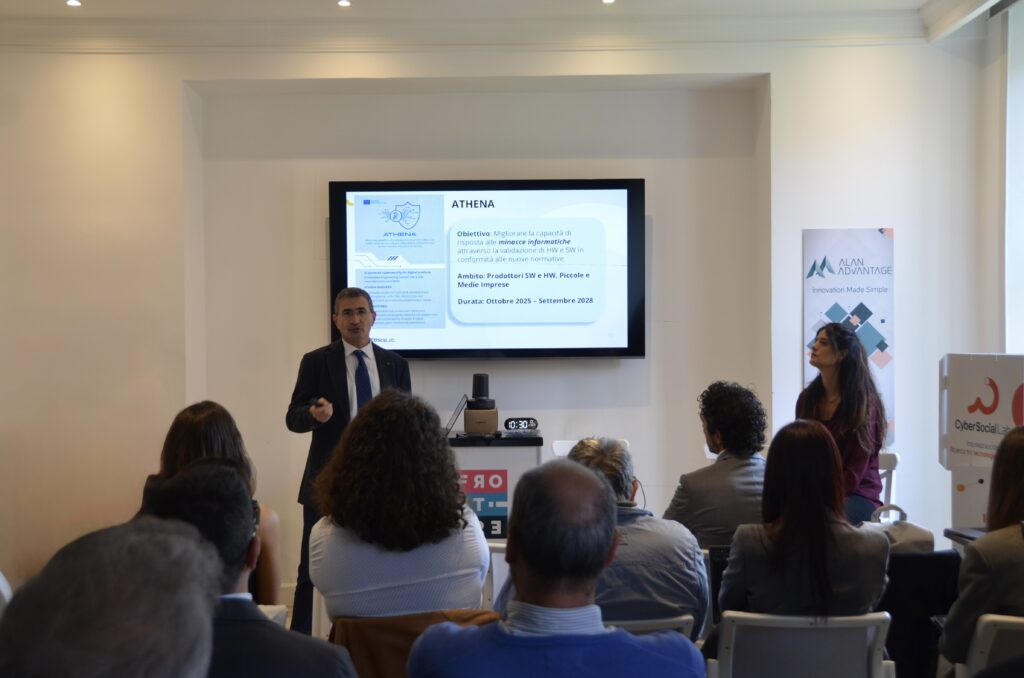
To address these challenges, European cybersecurity experts gathered in Rome for the workshop “Cybersecurity and SMEs: An Ecosystem for the Digital Resilience of SMEs.”
The event brought together businesses, researchers and cybersecurity professionals to explore practical solutions and encourage cooperation across Europe.
ATHENA Joins European Cybersecurity Projects in Rome
CyberEthics Lab., Frontiere and CyberSocial Lab. organised the workshop within the framework of four European cybersecurity projects: ATHENA, SECUR-EU, INTERSOC and CyberNEMO.
Our project partner, CyberSocial Lab (CSL), represented ATHENA and contributed to the organisation of the event.
The workshop provided an opportunity to share experiences, identify common challenges and discuss new approaches to improving cybersecurity for European SMEs.
Key Cybersecurity Challenges Facing SMEs
During the discussions, participants identified several barriers that prevent SMEs from improving their cybersecurity.
One major challenge is the lack of awareness, financial resources and specialised expertise. In addition, many smaller businesses struggle to identify and map their digital assets. As a result, they often cannot fully understand their exposure to cyber threats.
Another important topic was how companies perceive cybersecurity. Many SMEs still consider it an additional cost rather than an investment in business resilience.
However, cyber incidents can cause significant financial losses and operational disruption. Therefore, improving cybersecurity awareness is essential for long-term business protection.
Collaboration as a Solution for Stronger Cyber Resilience
Collaboration emerged as a key strategy for addressing these challenges.
Participants discussed how SMEs could benefit from working with larger companies, critical infrastructure operators and open-source communities.
For example, sharing cyber threat information, coordinating security services and pooling resources could help smaller organisations overcome their limitations.
These collaborative approaches can make cybersecurity more accessible and support a stronger European digital ecosystem.
The Role of Artificial Intelligence in Cybersecurity
Artificial intelligence (AI) was another important topic during the workshop.
Participants discussed an AI-based network traffic analysis solution developed by an SME. Initially, some chief information security officers (CISOs) expressed concerns about how the technology could affect their professional roles.
This example highlighted an important lesson: introducing new cybersecurity technologies requires both technical and organisational changes.
AI should support cybersecurity professionals, not replace them. By improving threat detection and supporting decision-making, AI-powered tools can help organisations strengthen their security capabilities.
EU Cybersecurity Regulations and Funding Opportunities
The workshop also explored the evolving European cybersecurity regulatory landscape.
One key topic was the Cyber Resilience Act (CRA), which introduces cybersecurity requirements for products with digital elements. Participants discussed its implications for SMEs and the challenges of adapting to new obligations.
In addition, discussions covered the Digital Omnibus initiative, including proposals to simplify overlapping regulatory requirements and streamline cybersecurity incident reporting.
The event also highlighted Horizon Europe funding opportunities for SMEs.
Furthermore, participants explored the policy brief “Towards an Ethical and Sustainable Enhancement of Cybersecurity Practices for European SMEs.”
Developed by CyberEthics Lab. within the SECUR-EU project, this document provides practical recommendations for improving cybersecurity among European SMEs. It was previously presented at the European Parliament in Brussels in June 2026.
How ATHENA Contributes to SME Cyber Resilience
The discussions in Rome closely align with ATHENA’s mission to strengthen software and hardware security across Europe.
ATHENA aims to support organisations, including SMEs, by developing innovative cybersecurity technologies that improve digital resilience and help address emerging threats. A central part of this approach is integrating security into software and hardware development from the earliest stages. By adopting secure development practices, organisations can identify potential risks before their products are deployed.
In addition, ATHENA is developing advanced tools for continuous vulnerability detection and assessment. These capabilities are complemented by innovative AI-based security services designed to improve threat detection, system monitoring and cybersecurity decision-making. Together, these technologies aim to help organisations identify vulnerabilities more effectively and strengthen their protection against evolving cyber threats.
Another important component of the project is the development of secure virtual testing environments. These environments will allow organisations to test and validate the security of software and hardware products under controlled conditions. Furthermore, ATHENA supports alignment with evolving European cybersecurity requirements, particularly the Cyber Resilience Act (CRA), by helping organisations assess their security measures and prepare for certification processes.
Through this integrated approach, ATHENA seeks to make advanced cybersecurity solutions more accessible to European businesses, including SMEs, while contributing to a safer and more resilient digital ecosystem.
Building a More Resilient Digital Future
The Rome workshop highlighted a clear message: improving SME cyber resilience requires more than technology alone.
Stronger cooperation, greater cybersecurity awareness and accessible security solutions are equally important.
By bringing together European projects, industry representatives and cybersecurity experts, the event encouraged knowledge sharing and new opportunities for collaboration.
ATHENA remains committed to supporting these efforts and contributing to a more secure and resilient digital future for European businesses.